
Branded Workwear for Muskoka Contractors:
Why Crew Shirts Pay for Themselves
More than four in ten households in Muskoka belong to people who don't live here. The District counts 22,377 second homes among 50,948 households in total, and a seasonal population of 84,400 that outnumbers the 66,674 permanent residents.
That shapes how a contractor gets found.
A large share of the people hiring here are in the area only a few weeks a year, which puts them out of reach of the advertising that works on year-round residents. Most of them hire on a neighbour's recommendation. Branded apparel reaches them anyway, because it works while the crew is standing in their neighbourhood doing work they can see.
The case for crew shirts gets built on what they cost rather than on what they return, because the cost is the only part anyone can measure.
What follows is what a season of shirts runs, where safety regulations override the branding decision, why blended fabrics behave differently under a press, and how to keep a crew in fresh shirts without ordering fifty at a time.
The Problem With Impression Numbers
Search for the value of vehicle wraps or branded apparel and one figure dominates: a wrapped truck generates 30,000 to 70,000 impressions a day, usually credited to an outdoor advertising association.
No published study supports that range. The number has survived on repetition, and a contractor budgeting against it is budgeting against nothing.
What A Season Of Crew Apparel Costs
Current member pricing at VirtualTees puts a heavyweight cotton tee at a bit over $9 in sizes S through XL, with 2XL around $14.50 and 3XL just over $20. Printing is $6.50 for the first location and $3.50 for each additional one.
A logo on the left chest and a company name across the back brings the shirt to roughly $19 before tax. A 50/50 hooded sweatshirt starts in the mid-thirties, or about $45 with the same two prints. Both are heavier garments than the giveaway shirts handed out at trade shows.
Outfitting a four-person crew with three tees and one hoodie each comes to roughly $410.
A work shirt that lasts two seasons will be worn well over forty times, which works out to under fifty cents a wearing. The hoodie costs more than twice what a tee does, but it stays in rotation through spring and fall after the tees are put away.
The catalogue also runs to long-sleeve shirts, polos, caps, and jackets, so a crew can be kitted out by role. Tees and hoodies go to the field. A polo suits whoever meets clients, and caps work for anyone. A logo on the chest works up close, at the door and across a counter, while the name across the back is what gets read from the road. Most contractors pay for both.
VirtualTees prints rather than embroiders, so a stitched logo means a different process and a different supplier.
Under CRA policy, a distinctive uniform an employee has to wear on the job isn't a taxable benefit, so $410 is the whole cost rather than a figure that grows on the T4. Regular clothing they can wear off hours for personal purposes doesn't meet that definition, which is what separates a shirt required on site from a logo hoodie handed out at year end.
Where High-Visibility Rules Take Over
Section 69.1 of Ontario's Construction Projects regulation covers workers who may be endangered by vehicular traffic. It specifies the garment exactly:
-
It covers at least the upper body.
-
The colour is fluorescent blaze or international orange.
-
Two yellow stripes 5 cm wide run down the front and cross in an X on the back, with a minimum amount of yellow set for each side.
-
The stripes are fluorescent and reflective, so they show up in daylight and in headlights.
-
A vest is adjustable and has a tear-away feature.
The Ministry also accepts garments built to the CSA Z96 standard, which allows yellow, silver, or a combination as long as the material does both jobs.
A t-shirt in Safety Green meets none of that. Safety Green and Safety Orange are stock garment colours, useful for spotting a crew across a residential site but not compliant high-visibility apparel.
The CSA classes are based on how much fluorescent fabric a garment carries, so a large enough print covers too much of it and costs the garment its rating. A compliant garment carries a label naming the standard and its class, which tells you in a second whether the gear a crew already owns still qualifies. Branding on the shirt worn underneath avoids the problem entirely, and that shirt is the one people see once the vest comes off at lunch.
Why Blended Fabrics Print Differently
Safety colours and heather colours are usually 50/50 cotton and polyester, even when the same style comes in 100% cotton in white or navy. Hooded sweatshirts are typically the same blend. The same logo reads slightly differently on a cotton tee than on a blended hoodie, so a sample of each shows what the crew will actually be wearing before the full order goes in.
A blend can fail a print two ways.
The first is heat. Polyester dye turns to gas when it gets hot, so a blend pressed at the temperature suited to cotton lets that dye move into the print and tint a white logo pink or grey, often a day after the shirt was made.
The second is movement. Screen ink and vinyl sit on top of the shirt instead of stretching with it, so they split where the fabric flexes hardest, across the shoulders and the chest. That's why an older print job tends to go first on the hoodies and the safety-colour tees rather than on the plain cotton ones.
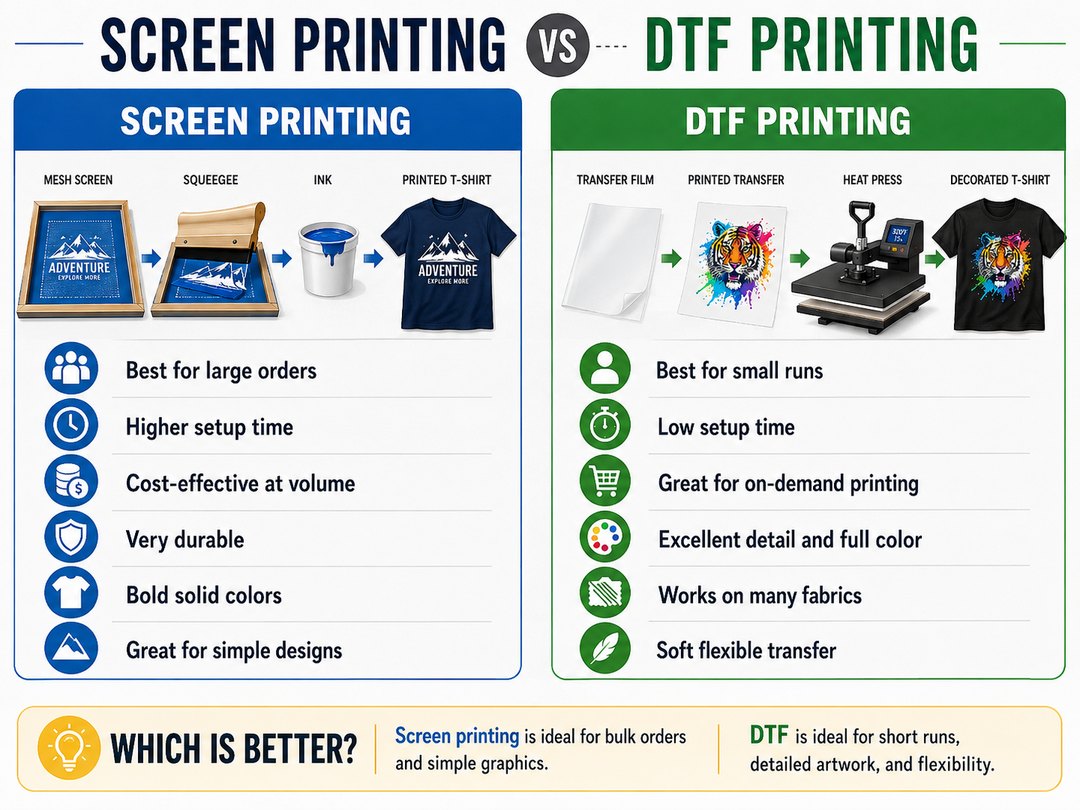
Direct-to-film printing, or DTF, handles blends better.
The design sits on a layer of white ink that blocks the shirt's own dye, and it bonds to the surface rather than soaking into the fibres, so it flexes with the fabric instead of cracking. Performance fabrics raise both problems, and the post on marina staff apparel works through them in more detail.
After that, the print lasts as long as the laundry allows:
-
Wash inside out, in cold water.
-
Skip the fabric softener.
-
Tumble dry on low, or hang to dry.
-
Never iron directly over the print.
Standing Reorders Keep The Crew Stocked
Most contractors still buy apparel in one bulk order, on the logic that minimums and setup fees make small runs uneconomical. Screen printing does charge setup per colour, so it only pays off in bulk. DTF has no setup, and shirt one costs what shirt fifty does.
A set stock level per employee works better. Three tees, one hoodie, and a cap cover most trades, ordered to that number so new hires get their apparel in the first week and sizes come off a real roster instead of a February guess.
The Small Business Program makes a one-shirt reorder practical:
-
Artwork stays on file between orders, so a reorder needs nothing more than the previous order details.
-
Most orders turn around in about three business days.
-
Pickup is in Bracebridge, or flat rate shipping is free over $199.
-
Members earn 5% back in credits.
Two ordering habits cover the year.
A standing order in early spring lands before every seasonal business in the district is ordering at once. A smaller top-up in midsummer carries the crew through to the end of the season. Production time runs from artwork approval rather than from the day you place the order, so proofing is where the spring order stalls.
Between those two orders, the state of the shirts sets the pace. A tee gone thin at the shoulders, or one with a cracked print, stops advertising and starts working against the look the order paid for, so it needs replacing.
DTF works best from a high-resolution file, a PNG at 300 dpi. VirtualTees handles basic artwork cleanup, though a logo saved off a website at screen resolution limits what any shop can do with it. Sending a proper file once fixes every order after it.
To get your crew's apparel organized before the next build season, get in touch with VirtualTees or sign up for the Small Business Program.