
Profitable Merch for Muskoka Breweries
Quality Apparel Items That Actually Sell
Merchandise sold across the taproom counter is a direct sale at full retail, with no distribution channel taking a share of it. It's sold in a room the brewery already staffs, to people who chose to spend an afternoon there, using artwork that has already been drawn, approved and printed for labels and tap handles.
With the sale, the space and the artwork already in place, the problems arise later. Merch programs stall on buying a season's stock in one go, on ordering too late, and on two rules that apply to liquor manufacturers and to few other businesses.
Deciding What Goes On the Garment
The first decision is whether a piece carries the brewery's own name or a single beer's, because the two last very different lengths of time on a rack.
The brewery's name, its logo and any graphic tied to the place stay sellable for as long as the brewery operates. These are the evergreen pieces. They can be reordered indefinitely, leftover stock in October is still current stock the following May, and they should make up the bulk of the rack.
A beer's own branding is different. A long-running flagship behaves much like the house name, but a seasonal or a one-off doesn't, and a hoodie carrying a rotation design is tied to a beer that may not exist in six months. That suits a deliberate short run and fails as something kept on the shelf year-round.
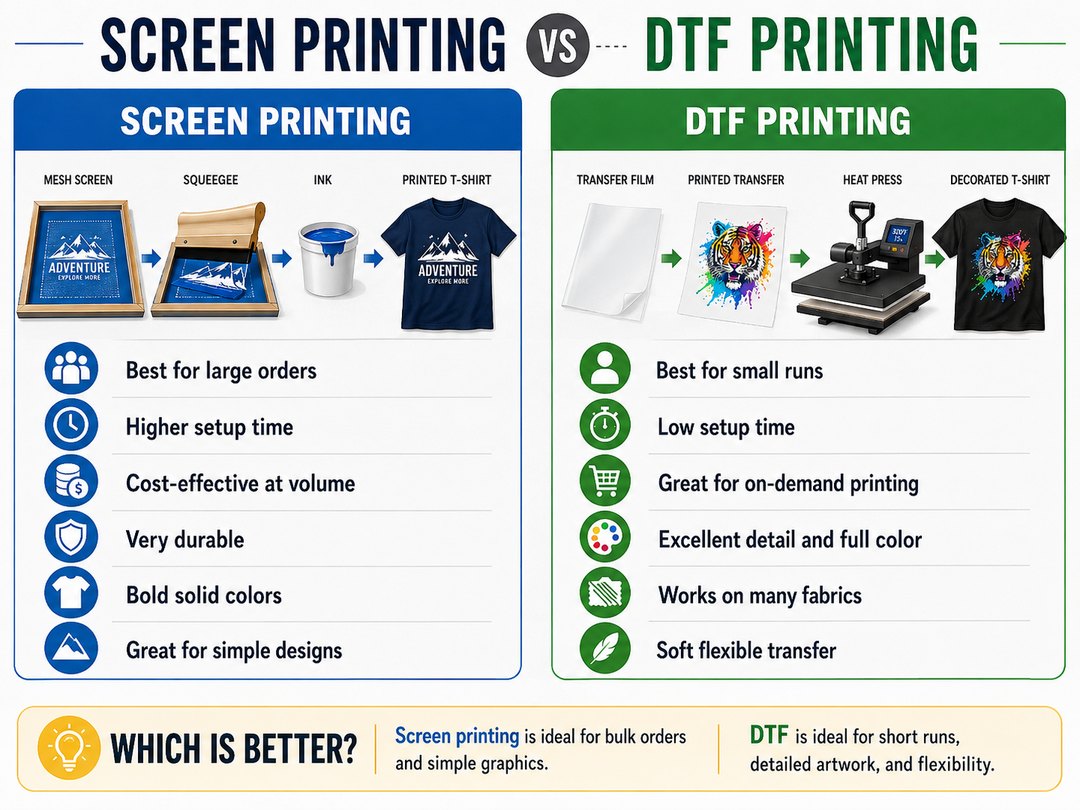
Low print minimums make those short runs possible, since a design can be printed twelve or twenty-four shirts at a time without committing to a quantity that outlives the beer. Custom T-Shirts and Minimum Orders explains the economics behind that, including why screen printing pushed everyone toward large runs.
Release-specific stock that doesn't sell through has two uses at the end of the season. It serves as staff clothing, or goes to the clearance rack in the quiet months, and neither use depends on the beer still being on tap.
Garments for a Taproom Rack
Taproom buyers judge a garment by picking it up.
Everything on the rack carries the same brewery's name, so there's no rival brand sitting beside it to judge against, and the decision rests on how the piece itself feels rather than on the label inside the collar.
Fleece that's garment dyed, meaning dyed after the sweatshirt is sewn, comes out with a softly faded colour that suits cottage country better than flat, uniform colour does. Heavy fleece is normally a cotton and polyester blend, and better garments are knit so the outward-facing surface is pure cotton. That surface carries the print, which holds to cotton more reliably than to a blend.
The same split applies to tees. A heavier garment-dyed tee has a roomy cut and holds its shape and colour through repeated washing, which makes it the stronger choice for resale. The lighter, smoother cotton tee is the alternative. It sits closer to the body and repeats the same colour exactly from one order to the next, while garment dyeing produces shade variation between pieces.
The VirtualTees catalogue lists weight, fabric and fit for every style it carries, with Comfort Colors, Bella+Canvas and Gildan among the brands stocked. Anything outside it can usually be brought in on request, and a sample ordered ahead of a full run answers what a listing doesn't cover, principally softness and fit.
Three or four designs with plenty of each sell better than a dozen designs with two of each, and two colours per design is usually enough. Weight the sizes toward medium, large and extra large, and stock small and 2XL lightly rather than skipping them. 12 Product Ideas for Summertime Muskoka Tourism Businesses covers the products beyond apparel that suit a seasonal rack.
Placement affects both cost and what sells. A left chest logo is the cheapest option and reads as staff wear, while a full front or back graphic is what sells as a souvenir. A second printed area costs less than the first, so front-and-back is a smaller step up in price than it appears.
Timing Drops Against the Brewery Calendar
A merch calendar works best pinned to dates already on the production schedule.
Spring stock should be ordered in April, alongside whatever seasonal is being packaged, and kept small enough to be a test. A restock in the second week of July, weighted toward what sold in June, puts the busiest weeks on results rather than on a spring prediction.
Fleece is where the schedule most often slips. Ordering in August puts stock on the rack before the late September window opens, while stock arriving in mid-October misses much of it.
November buying favours the brewery's own name over anything release-specific, since whoever receives the gift may not follow the brewery closely enough to recognise a seasonal beer.
Anniversaries, tap takeovers and festival appearances all justify short runs. A design tied to a single weekend can be printed a dozen at a time and sold out, leaving nothing to carry into the following year.
Pricing for Taproom Retail
The cost per piece is the garment plus the printing. Member printing runs $6.50 for the first printed area on a garment and $3.50 for each additional one, so a chest logo with a back graphic is $10 a piece, charged per garment and unchanged by order size. Apparel Printing for Small Businesses in Muskoka sets out member garment pricing, turnaround and the ordering steps in full.
Retail clothing is normally priced at double what it costs to produce, and souvenir retail generally sits in the same range.
Two pricing mistakes recur.
The first is treating merchandise as advertising and setting the price barely above what the piece cost to make, which surrenders the margin and tends to make customers value the shirt less. The second is discounting current stock during the busy months. Clearing leftovers in February costs far less than eroding margin in July.
Selling Beyond the Taproom
Shipping apparel is simpler than shipping beer.
Sending beer to a customer means working inside the rules that govern liquor delivery, while a hoodie goes to any address in Canada as an ordinary parcel. For a brewery running an online store, that makes a taproom design available to a summer visitor in February from Toronto or Ottawa.
The buying context differs as well.
A shirt bought on site is a souvenir of a visit, while the same shirt bought online six months later is bought for the brewery's name alone, which is a further argument for keeping evergreen pieces at the centre of the rack and listing those online rather than the rotating designs.
Filling those orders takes either stock on hand or a printer who can turn work around quickly. Small Business Program orders are typically ready in about three business days, short enough to fill online orders in small batches instead of holding a season's inventory for them.
Where AGCO Rules Touch Merchandise
Breweries already clear artwork against Ontario's liquor advertising rules for every label and campaign they run, and those rules follow the brand onto a garment. The AGCO holds manufacturers responsible for all advertising carrying their identification, and merchandise is named in that provision, so a hoodie is governed the same way a can is. Artwork already cleared for a label needs no second look.
However, a gift that requires the purchase of liquor has to be of nominal value, capped at 20 percent of the retail price of the product it comes with. A sticker falls inside that limit and a hoodie doesn't. Apparel can still be sold alongside beer, provided a charge of at least cost is added to the regular price and the item is clearly visible to the buyer.
The second restriction covers staff uniforms, which appear on the AGCO's list of prohibited inducements. Manufacturers can't supply them to licensed establishments that sell their product. That rules out printing shirts, polos or aprons for the staff of a bar or restaurant that pours the brewery's beer, whatever the arrangement is called.
It says nothing about a brewery clothing its own people. Shirts for taproom servers, production staff or a festival booth crew are ordinary work apparel, and Marina Staff Apparel Built To Survive covers the fabric and durability side, which applies as readily to a hot brewhouse or a summer patio shift.
Getting Started
A sensible first step is two evergreen designs pulled from artwork the brewery already owns, twelve of each, counted at month end and reordered according to what moved. Release-specific pieces can follow once it's clear how the brewery's own name sells.
Two months of that is enough to show which design carries the rack and which sizes run out first, and those two facts decide most of what the next order should be.
VirtualTees is based in Bracebridge, prints locally with no minimums, and works with seasonal Muskoka businesses on exactly this kind of program. For help choosing garments or building a drop schedule ahead of a fall order, get in touch with VirtualTees.